Hello again! Since sitting my last undergraduate exam at the end of May (and moving into the CASS centre only 3 days later) I’ve been dealing with a transition from the UG life I had once known to a new, postgraduate lifestyle. Something that certainly sped up this acclimatisation was the seventh international Corpus Linguistics conference (CL2013), which I attended last week as a student volunteer.
This was my first ever academic conference and, as you might expect, I approached the week with a lot of uncertainty in my mind. In terms of how the week would pan out I really had no idea what to expect and, among other things, I was a little nervous about meeting the faces behind some of the famous names I had read about in the corpus linguistics world. I was particularly excited about meeting a few people because I had read through most of the abstracts weeks in advance of the conference (most of my “CASS-time” in June was spent editing together the Word documents into a mahoosive, 370 page long abstract book…).
As a volunteer I spent most of my week wearing a beautifully designed bright blue t-shirt and a matching, equally beautiful bright green conference bag. Aside from setting international fashion trends, I got to sit in on most of the talks that tickled my fancy while helping out with any technical issues etc. All speakers (other than the daily plenaries) were given a 20 minute slot and then 10 minutes afterwards to answer any audience questions. It was fascinating to witness first hand the breadth and depth of research that is currently being advanced using corpus-based methods, as well as the really informative and productive discussions that followed each talk. I really got the sense that, despite everyone’s individual research interests, this was very much a community in which we’re all fighting the same metaphorical battle. And as the week went on I really started to get (admittedly geekily) excited about joining such a community of researchers.
As well as furthering my interest in the subject and witnessing how seriously it can be taken (there was a fairly animated discussion about p-values that I’ll not soon forget…) there were also some moments that I didn’t expect to enjoy as a conference blueshirt (yes, it became a noun). Interrupting Michael Hoey’s plenary talk to hand-deliver him my own bottle of water (after which he jokingly complained that it wasn’t beer); having a nice one-to-one with Guy Cook while escorting him back to the hotel; being in the same room as John Kirk whenever he started talking, and taking advantage of the free wine at the Gala dinner with David Wright were all highlights.
But, for me, the real highlight of the whole conference was the official CASS launch night. I remember back in April a rushed conversation outside on campus with Amanda Potts (conference organiser), where she asked me if I wanted to present a poster at the CASS launch night. A poster of what? was my first thought (aside from the shock of being asked with a faceful of Greggs’ sausage roll…), since at the time I hadn’t even finished my degree and couldn’t think of anything I’d be confident enough in to unleash on anyone – let alone a room full of experienced corpus linguists and important people from the Home Office and the like. But of course I said yes and finished off my sausage roll wondering what I’d let myself in for.
When the time came to prepare something, I’d decided on an undergrad assignment that I completed for the corpus linguistics module only earlier this year. I had used corpus methods to compare the language of the MPs in favour of and against legalising the Marriage (Same Sex Couples) Bill in a debate earlier this year. By sheer luck, the bill was indeed passed only days before the conference, so the poster that I had made to present at the launch night got a bit more attention than I expected!
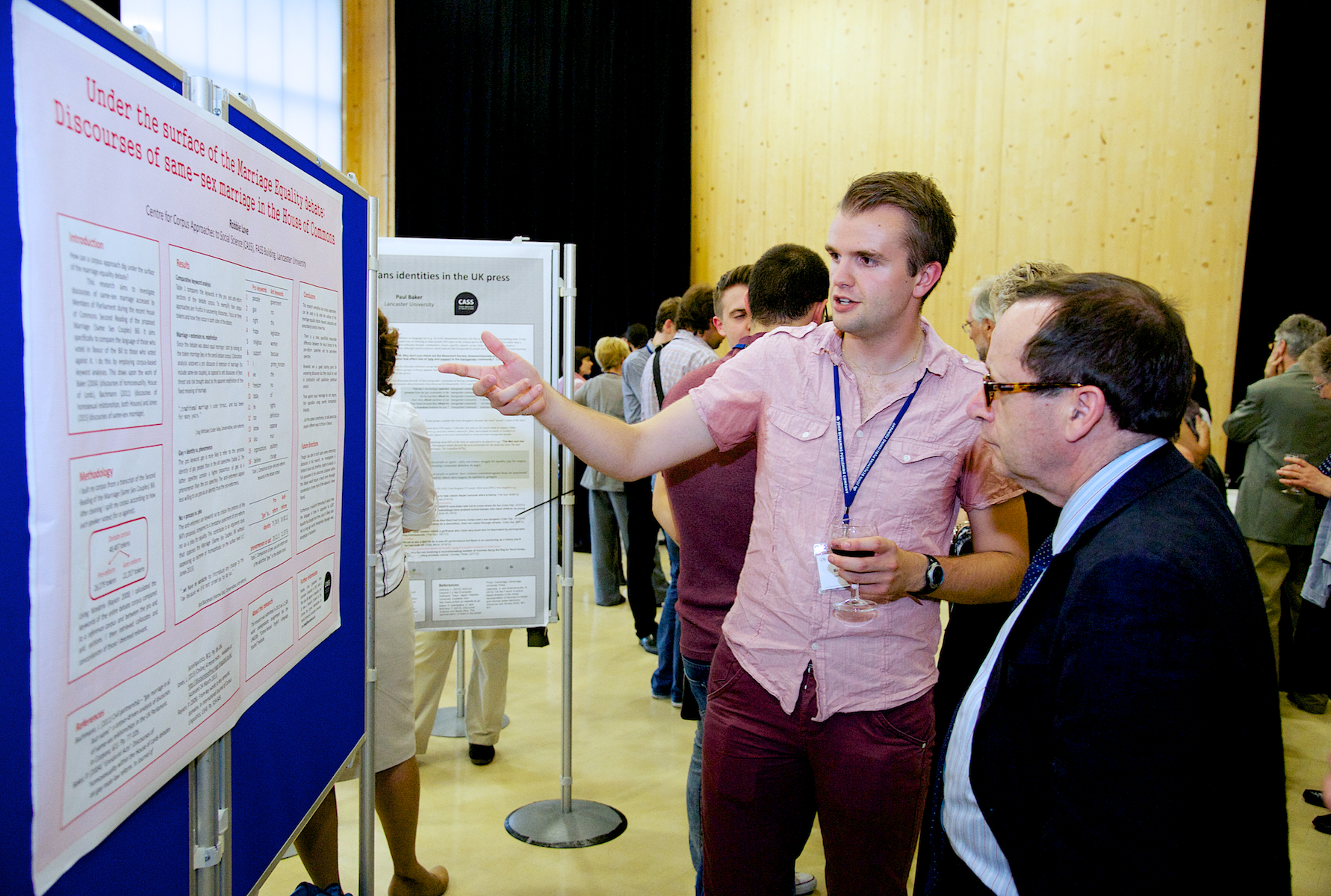
Hob-nobbing with Bernard Silverman, the Chief Scientific Advisor to the Home Office.
Aside from being mentioned twice in a speech by former Home Secretary Charles Clarke (which caused my face to match the colour of my shirt), my work took the interest of the Chief Scientific Advisor to the Home Office, Bernard Silverman. As you can see above, we had a good old natter about it while I clutched on to my glass of red wine, apparently looking like a sweating, pointing maniac. Despite this (and how I picked a shirt that I had forgotten was missing a button and therefore showed a bit more chest than I really deemed appropriate…) I think the main message from the night was one of encouragement. It certainly helped me settle my worries about whether or not I was really ready for this sort of thing. I think I can safely say now that I was!
All in all, CL2013 was a brilliant week that helped me in numerous ways. Aside from helping me keep my tummy full all week (the food was, like, AMAZING) it helped bridge the gap in my mind between where I am now and where I can hope to be in the not too distant future. And with the announcement that Lancaster would once again host the next Corpus Linguistics conference in 2015 (by which time I’ll be a first-year PhD student) it’s nice to feel like the only way is up.

 Dr Robbie Love