Applications of Corpus Linguistics
Established and Emergent Contexts
Edited by Gavin Brookes, Niall Curry and Robbie Love (2026)
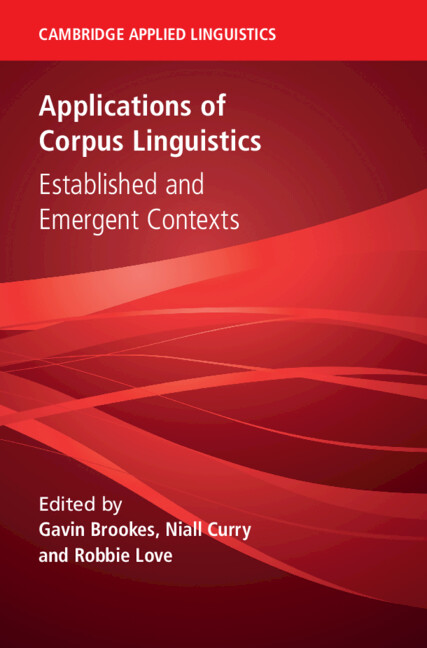
Bridging the gap between linguistic theory and practice, this timely book demonstrates the transformative potential of corpus linguistics research and methods across a wide range of contexts. With contributions from a diverse range of authors, this book provides contemporary reflections on both established applications in language education, as well as emergent contexts in which corpus methods are driving social change, such as the media and law. Each chapter provides case studies that clearly demonstrate pathways from theory and analysis to application and impact, making the theory accessible without assuming specialised knowledge of specific contexts. Featuring the development of innovative methods and tools, the book shows readers that corpus linguistics is a discipline attuned to both methodological and societal impact. Showcasing the cutting-edge contributions that corpus linguistics is making to contemporary applied linguistics, this book is essential reading for academics, professionals, and anyone interested in the practical application of language data.
Check it out on the Cambridge University Press website!
Researching Stylistics
A Student Guide
By Furzeen Ahmed, Marcello Giovanelli, Caroline Godfrey, Chloe Harrison, Robbie Love, Megan Mansworth, Stephen Pihlaja and Ella Wydrzynska (2026)
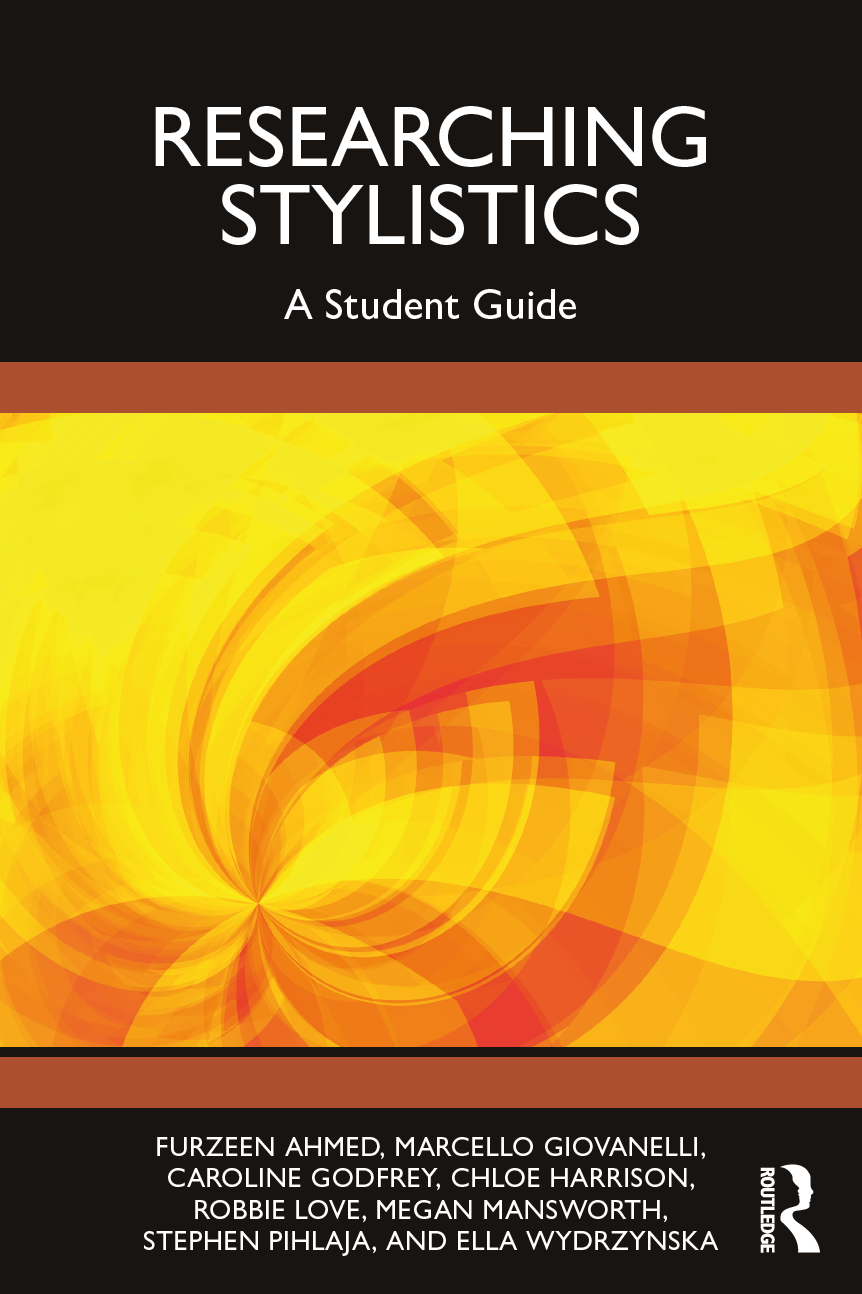
Researching Stylistics: A Student Guide explores key topics in literary and non-literary stylistics, examining the multiple ways in which students can undertake research in this discipline. Inherently practical and reader-friendly in focus, the book is both a guide to key elements of the research process and a useful overview of core knowledge and successful research projects in stylistics.
The book provides an overview of stylistics as a discipline, identifying its core principles and working parameters. It outlines, in a clear and systematic way, the design stages and practical considerations needed to plan for and undertake research. Reflecting the latest thinking in contemporary stylistics, the book demonstrates how various methods can be applied to study a range of different text types. The practical activity of ‘doing’ stylistics and key examples from existing research are emphasised so that readers will be confident in their ability to apply their knowledge to their own working contexts.
This is an essential text for advanced students and researchers working in stylistics and discourse analysis, and those working in interdisciplinary spaces who would be interested in exploring how stylistics can support their work.
Check it out on the Routledge website!
Reading Habits in the COVID-19 Pandemic
An Applied Linguistic Perspective
By Abigail Boucher, Marcello Giovanelli, Chloe Harrison, Robbie Love and Caroline Godfrey (2024)

This book presents and analyses the results of the Lockdown Library Project survey, using a range of quantitative and qualitative approaches to provide a unique insight into the ways in which the first UK COVID-19 lockdown affected public reading habits. The authors begin by outlining the background to the study, the research methodology and design, and an overview of the headlines of the data, before going on to survey the literature on the relationship between pandemics, literature (especially the role played by genre and popular fiction) and reading habits. They then examine how participants reported that the lockdown period had affected the amount that they read; how they accessed books and discussed their reading with others; the use of reading as a coping strategy; and returning to re-read books that offered familiarity, reliability, and nostalgia. Finally, the concluding chapter brings together the overall findings of the project and briefly outlines future work in the field. This book will be of interest to academics in fields such as literary and genre studies, applied linguistics, corpus linguistics, stylistics, health humanities, and sociology, as well as practitioners working in education, in bibliotherapy, and in libraries.
Check it out on the Springer website!
See review by Amélie Doche for English Studies (2024).
Overcoming Challenges in Corpus Construction
The Spoken British National Corpus 2014
By Robbie Love (2020)
This volume offers a critical examination of the construction of the Spoken British National Corpus 2014 (Spoken BNC2014) and points the way forward toward a more informed understanding of corpus linguistic methodology more broadly. The book begins by situating the creation of this second corpus, a compilation of new, publicly-accessible Spoken British English from the 2010s, within the context of the first, created in 1994, talking through the need to balance backward capability and optimal practice for today’s users. Chapters subsequently use the Spoken BNC2014 as a focal point around which to discuss the various considerations taken into account in corpus construction, including design, data collection, transcription, and annotation. The volume concludes by reflecting on the successes and limitations of the project, as well as the broader utility of the corpus in linguistic research, both in current examples and future possibilities. This exciting new contribution to the literature on linguistic methodology is a valuable resource for students and researchers in corpus linguistics, applied linguistics, and English language teaching.
Check it out on the Routledge website!
See reviews by Jiawei Wang for the International Journal of Corpus Linguistics (2020), Siqi Liu for Natural Language Engineering (2021) and Lizzy Hanks for Register Studies (2023).
Corpus Approaches to Contemporary British Speech
Sociolinguistic Studies of the Spoken BNC2014
Edited by Vaclav Brezina, Robbie Love and Karin Aijmer (2018)
Featuring contributions from an international team of leading and up-and-coming scholars, this innovative volume provides a comprehensive sociolinguistic picture of current spoken British English based on the Spoken BNC2014, a brand new corpus of British speech. The book begins with short introductions highlighting the state-of-the-art in three major areas of corpus-based sociolinguistics, while the remaining chapters feature rigorous analysis of the research outcomes of the project grounded in Spoken BNC2014 data samples, highlighting English used in everyday situations in the UK, with brief summaries reflecting on the sociolinguistic implications of this research included at the end of each chapter. This unique and robust dataset allows this team of researchers the unique opportunity to focus on speaker characteristics such as gender, age, dialect and socio-economic status, to examine a range of sociolinguistic dimensions, including grammar, pragmatics, and discourse, and to reflect on the major changes that have occurred in British society since the last corpus was compiled in the 1990s. This dynamic new contribution to the burgeoning field of corpus-based sociolinguistics is key reading for students and scholars in sociolinguistics, corpus linguistics, pragmatics, grammar, and British English.
Check it out on the Routledge website!
See review by Huayong Li for Digital Scholarship in the Humanities (2019).
 Dr Robbie Love